
What 1.3 Million Brand Pitches Taught Us About Getting Replies
We looked at nearly 1.3 million first pitches that creators sent to brands through Bento between June and October 2026, and asked a simple question: what do the pitches that get a “yes, tell me more” have in common?
Here’s the short version:
- Do: open with something warm and specific about the brand, describe yourself and your audience in one concrete sentence, and end with an easy question about working together.
- Don’t: critique the brand’s content, ask for a call, mention your rates, or use a clickbait subject line in your first email.
Each rule is a nudge, not a magic phrase, so use them together. Below are the 7 rules we took from the data, with examples of each.
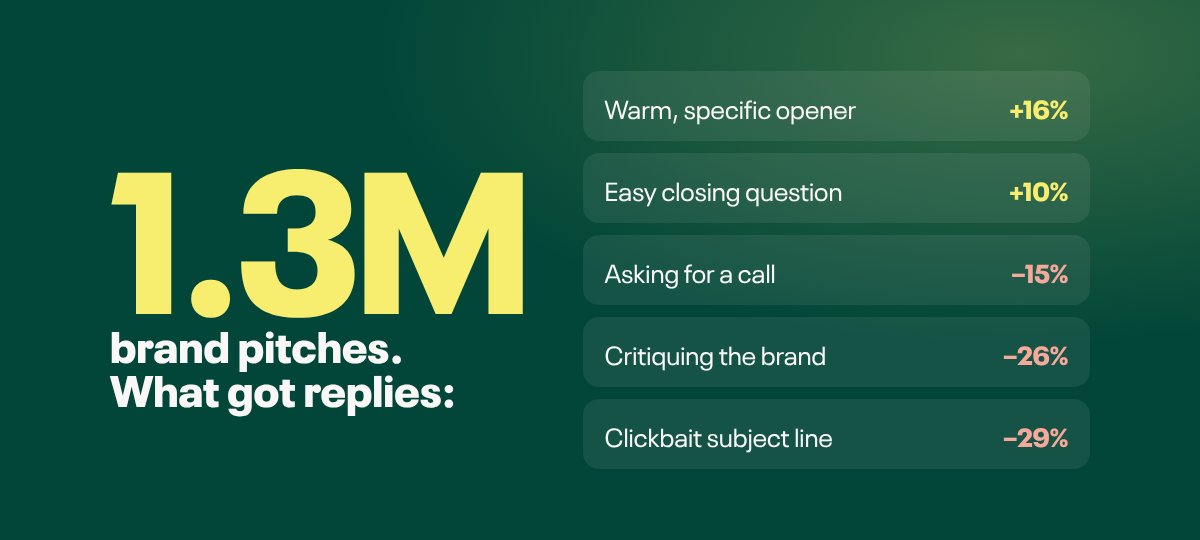
7 brand pitch email rules that got more positive replies
| Pitch choice | Effect on positive replies |
|---|---|
| Warm, specific opener about the brand | About 16% more |
| Easy, partnership-framed closing question | About 10% more |
| One concrete detail about you and your audience | About 8–9% more |
| Mentioning rates or budget | About 12% fewer |
| Asking for a call or meeting | About 15% fewer |
| Critiquing the brand’s content | About 26% fewer |
| Clickbait or fake “Re:” subject line | About 29% fewer |
1. Open warm and specific about the brand
About 16% more positive replies.
Your first line should prove you know this brand and actually like something about it. Not “I love your brand!” but something only a real fan would say.
✅ “You had me at a mineral sunscreen that doesn’t leave a white cast.”
❌ “I came across your brand and thought we’d be a great fit.”
The specific line shows you’re writing to them. The generic line could have gone to 500 brands, and brands can tell.
2. Give one concrete, true detail about you and your audience
About 8–9% more positive replies.
Tell the brand who you are and who’s watching you, in one sentence. One sharp detail beats a list.
✅ “I’m a dog trainer, and most of my followers are first-time puppy owners.”
❌ “I create content across lifestyle, travel, beauty, fitness, tech and food.”
A long niche list tells the brand you don’t have a clear audience. One concrete detail lets them picture exactly who will see their product, and it helps you stand out. Brands read a lot of pitches, and a detail only you could write is the one they remember. Not sure what yours is? Find your unique angle first.
3. End with an easy, partnership-framed question
About 10% more positive replies.
Finish with one question that’s easy to answer and is about working together.
✅ “Are you working with creators on any upcoming campaigns?”
✅ “Would it help if I sent over a couple of ideas?”
Pitches that ended with no ask, or a vague “let me know!”, did worse. Give the brand an easy next step.
4. Don’t ask for a call in the first email
About 15% fewer positive replies when you do.
“Would you be open to a quick call?” asks a stranger to give you their time before they’re interested. Save it for after they reply. A call is a great second step and a weak first one.
5. Leave your rates out of the first email
About 12% fewer positive replies when you include them.
Mentioning pricing, rates or budget in a first pitch turns the brand’s first reply into a negotiation, and many brands just don’t reply. Get them interested first. When they ask about rates, here’s how to negotiate.
6. Never critique the brand’s content
About 26% fewer positive replies.
This was one of the worst-performing openers we saw:
❌ “Love your Instagram! I noticed a few small changes that could make your videos perform a lot better.”
It might feel like you’re showing expertise, but to the person who made those videos, it reads as an insult from a stranger. One template that paired this opener with a clickbait subject line went out nearly 1,000 times and got zero replies. Pitch what you’d add, not what they’re doing wrong.
7. Skip clickbait subject lines
About 29% fewer positive replies with clickbait.
Avoid fake “Re:” subjects, “You forgot this”, “Hey, did you forget this??” and anything else that tricks the brand into opening. It starts the relationship on the wrong foot. A strong subject line is specific to the brand, your audience or the moment. Here are subject lines, graded.
Put it together: a pitch built from the data
Here’s a pitch that follows all 7 rules:
Subject: {specific to the brand, your audience or the moment, with no tricks}
Hi {First name},
You had me at {specific thing you love about the brand or product}.
I’m {name}, a {one concrete detail about you}, and most of my followers are {who your audience is}. My last {content type} for {similar brand} got {plain result}, and I think {product} would land the same way with them.
Are you working with creators on any upcoming campaigns?
Thanks, {Your name} {Handle} | {portfolio link}
Notice what’s not there: no call request, no rates, no niche list and no tricks in the subject line. It’s short enough to read in under 20 seconds.
Want this done for you?
Bento’s pitch writer follows these rules automatically. It finds brands that fit your audience, writes a personalized pitch for each one, and follows up for you. Sign up here to get started.
Frequently asked questions
What makes a brand pitch email get a reply?
In our data from nearly 1.3 million first pitches, the pitches that earned more positive replies opened with something warm and specific about the brand, described the creator and their audience in one concrete sentence, and ended with an easy question about working together. The ones that earned fewer critiqued the brand, asked for a call, mentioned rates, or used clickbait subject lines.
Should I ask for a call in my first pitch email?
No. First pitches that asked for a call or meeting got about 15% fewer positive replies. Ask an easy question instead, like whether they're working with creators on upcoming campaigns, and suggest a call once they've replied.
Should I include my rates in a brand pitch?
Not in the first email. Pitches that mentioned rates, pricing or budget got about 12% fewer positive replies, because the first reply becomes a negotiation before the brand is interested. Share your rates once they ask.
What subject lines should I avoid in a brand pitch?
Clickbait and tricks. Fake 'Re:' subjects and lines like 'You forgot this' got about 29% fewer positive replies. Make your subject line specific to the brand, your audience or the moment instead.
Stop waiting to be discovered.
Bento finds the brands, writes the pitch, and follows up — so you land more paid deals.
Start landing deals →